

INEC partners NOA to tackle vote-buying, disinformation ahead of 2027
By Emmanuel Oloniruha
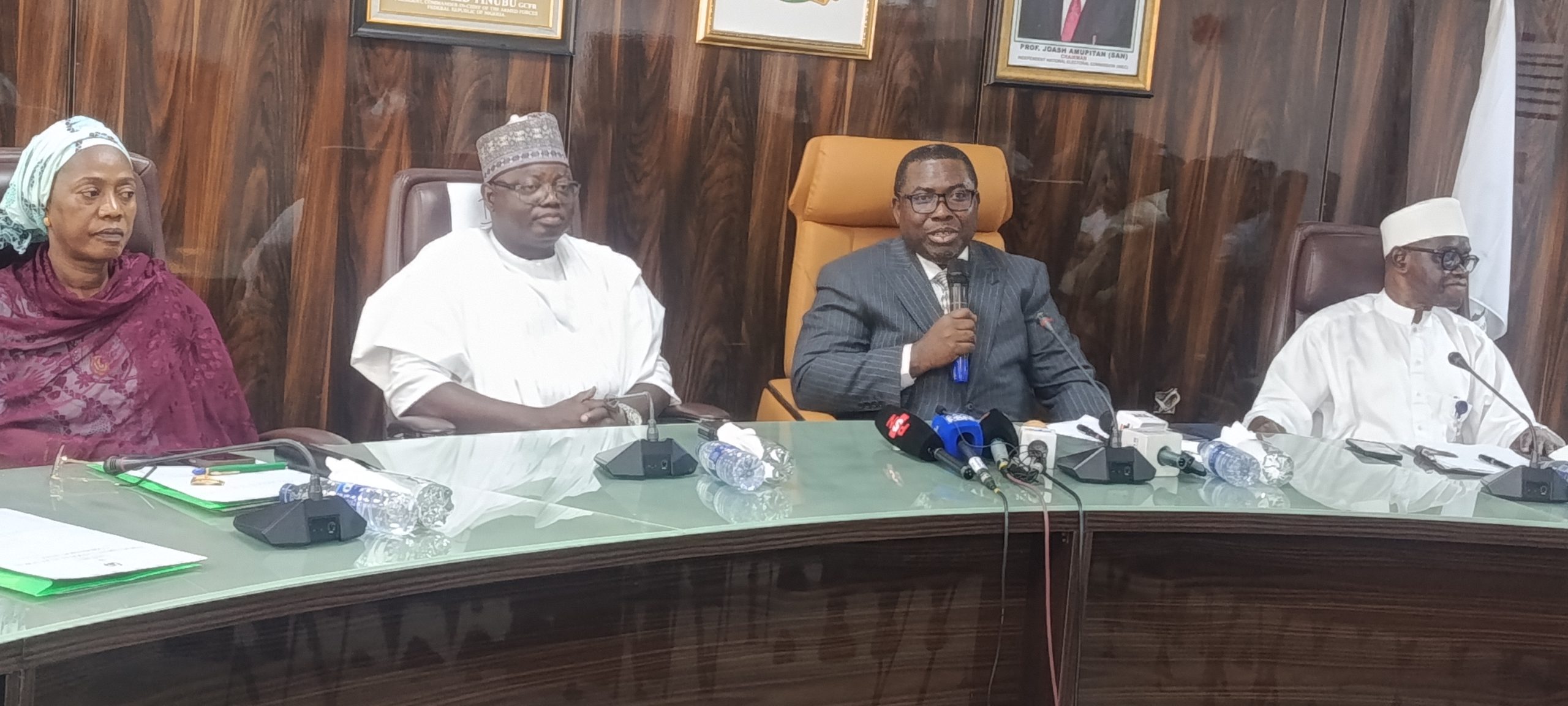
The Independent National Electoral Commission (INEC) has partnered with the National Orientation Agency (NOA) on grassroots voter education campaign to restore public trust and protect the integrity of the ballot box.
The INEC Chairman, Prof. Joash Amupitan, announced the collaboration during a visit by the leadership of the NOA to the commission’s headquarters in Abuja.
Speaking on the urgency of the partnership, the chairman described the deep-seated “trust deficit” among the electorate as a silent and dangerous enemy confronting the nation’s democracy.
He noted that while technological upgrades like the Bimodal Voter Accreditation System (BVAS) and the INEC Result Viewing Portal (IReV) had significantly improved election transparency, robust civic education is required to bridge the gap in public familiarity.
“We need to co-create a decentralised, grassroots voters’ education campaign that goes beyond simply telling them when to vote.
“We need to teach them why their vote matters and how our legal and technological safeguards protect their choices,” Amupitan said.
The INEC chairman also emphasised the need for joint collaboration to sensitise grassroots people on the electoral process, especially the rural farmer and the market women.
He argued that technology and logistics alone could not sustain democracy if citizens remain detached.
He described the NOA as Nigeria’s premier organisation for civic orientation and the custodian of values that shape public opinion.
Amupitan urged the agency to leverage its extensive network across the 36 states and all local government areas to change negative narratives.
The INEC boss stressed the need for the joint team to design aggressive, digitally driven campaigns targeted at the youths and the mass population to combat the two menaces of vote-buying and targeted disinformation.
He warned that malicious actors frequently deploy old, manipulated media to incite fear and scare voters away from polling centres.
“Disinformation is when you know it is not true, and you are presenting it to the public that it is true. That threatens and contaminates our democracy. Field officials must act as trusted ambassadors of truth,” he said.
He warned that allowing deliberate misinformation to thrive on electoral process would continue to erode people’s confidence in the electoral process and discourage their participation.
Amupitan cited the recent video clip that was deliberately circulated on social media during the recent Ekiti governorship, describing it as false and part of the alarming disinformation attempted to discredit the country’s electoral system.
“In the last election, you notice the video that was going around and saying that INEC had warehoused more than 100,000 PVCs for a particular political party and they were sharing and distributing it.
“But on its close and improper forensic scrutiny, it was discovered that what was being shared was not INEC. It was party membership cards.
“But somebody decided to sit in the comfort of its room to just come with that act of mischief that is aimed at eroding people’s vote,” Amupitan said.
The Chairman said that both institutions must begin immediate citizens sensitisation rather than waiting for the eve of the 2027 general election.
Amupitan pledged that INEC’s doors remain open to provide data, tools, and institutional support to ensure the partnership succeeds.
Earlier in his remarks, the NOA D-G, Issa Onilu, commended INEC for recording a drastic reduction in genuine electoral complaints across recent off-season elections, attributing the success to evolving improvements in Nigeria’s electoral system.
Issa-Onilu noted that data from the last three off-season governorship elections indicated that the nature of Nigeria’s elections was positively changing.
He, however, emphasised the need for more voter education, stating that democracy remains the bedrock of the country’s survival, emphasizing that the civic right of citizens to choose their leaders must be protected and promoted by all stakeholders.
Reflecting on the 2023 general elections, Issa-Onilu highlighted the massive surge in youth participation, particularly among the “Gen Z” demographic.
However, he noted that the milestone came with a prominent drawback: a significant gap in voter education and democratic knowledge.
He expressed concerns on productive time that was wasted on post-election debates that should never have occurred, such as misunderstandings regarding the statutory requirement for a candidate to secure 25 per cent of votes in the Federal Capital Territory (FCT).
To bridge this gap, Issa-Onilu outlined three key requests to the INEC Chairman to formalise and scale up structural collaboration between both agencies
These according to him include; moving away from ad-hoc, three-month pre-election voter sensitisation campaigns to a continuous voter education.
He also sought INEC’s support to amplify civic and voter education across the NOA’s vast national infrastructure, which spans 818 offices nationwide (including all 774 Local Government Areas, 36 states, the FCT, and 6 zonal directorates).
He also proposed strengthening direct working ties between INEC and the NOA’s Department of Civic Values and Democracy Education.(www.primerisenews.com)
Leave a Reply