

By Emmanuel Oloniruha
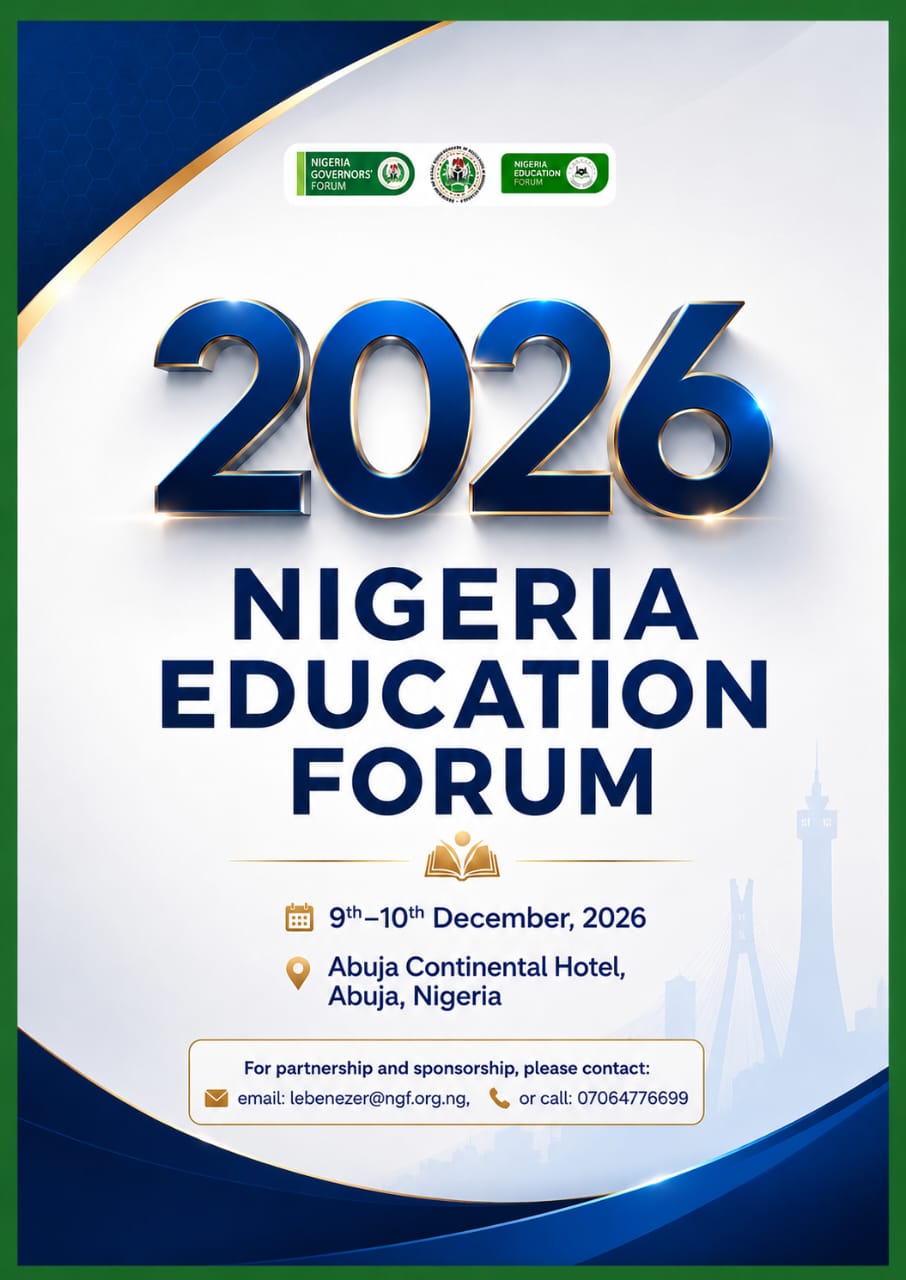
The conveners of the 2026 Nigeria Education Forum (NEF) says that the education summit will explore innovative solutions to foundational learning deficits, skill gaps, financing constraints, and increasing foreign education spending.
The focus of the summit was disclosed in a statement by the NEF 2026 Media Unit, in Abuja on Wednesday.
“it said that the two-day workshop themed ‘Education Import: Transforming Nigeria’s education system for local impact and global competitiveness,’ holds between Dec. 9 and Dec. 10 at the Abuja Continental Hotel.
The NEF Media Unit said the Committee of States’ Commissioners of Education in Nigeria (COSCEN), Nigeria Governors’ Forum (NGF) and the Federal Ministry of Education (FME), will jointly host the 2026 edition of the Forum to address Nigeria’s pressing educational challenges.
It said that governors, minister of education, commissioners of education, development partners, education experts and other stakeholders would be expected to discuss measures to improve Nigeria’s education system.
“The NEF 2026 would facilitate reflection on creative solutions to address the subnational education sector’s pressing challenges, focusing on foundational learning deficits and weak skills alignment;
“Rising education import and capital flight, limited research productivity and innovative ecosystem, education financing constraints and sustainability risks, access, equity and regional disparities, governance fragmentation and institutional capacity gaps.
“Education experts will also discuss how to adapt effective international practices to Nigeria’s education needs and challenges, raise pupils’ and students’ academic performance, and equip young Nigerians for changing workplace demands,” it added.
The forum noted that Nigeria’s rapidly growing and youthful population makes comprehensive education reform increasingly urgent.
It stated that about 43 per cent of Nigerians are currently under the age of 14, with the nation’s population projected to approach 400 million by 2050.
The forum noted that the growing youth population could contribute to economic growth if they acquire relevant knowledge and skills.
“However, several challenges continue to limit this potential, including inadequate funding, unequal access, poor performance in basic literacy and numeracy, and a gap between graduates’ qualifications and the skills employers require.
“The summit will examine how curricula, teaching methods, and training programmes can better equip learners with digital, technical, analytical, and problem-solving skills to meet evolving workplace demands.
“ Participants will consider how schools, vocational institutions and universities can respond to artificial intelligence, automation, and other technologies,” it added.
The forum also said that the summit would also examine “education import” and the implications of Nigerians seeking educational opportunities abroad, including the funds spent on tuition, accommodation, and related costs.
It said that reports referencing Central Bank of Nigeria data indicated that Nigerians spent about $1.39 billion on foreign education in the first half of 2025, with expenditure estimated at $11.1 billion between 2020 and mid 2025.
The organisers said that while international exposure offers valuable experience, the significant capital flight underscores the need to enhance the quality, capacity, and global competitiveness of local institutions.
It added that the forum aimed to foster international partnerships, promote research collaborations, and engage the Nigerian diaspora to build local institutional capacity rather than discourage overseas study.
It said that the summit would deliberate on five main priority areas: education quality, skills, and employability; research, innovation, and global academic visibility; education financing and sustainability; inclusion and human capital development; and governance and system strengthening.
It added that discussions would cut across basic and secondary education, Technical and Vocational Education and Training (TVET), higher education, informal learning, and lifelong education.
“Participants will also explore sustainable funding models, including public-private partnerships (PPPs) and domestic resource mobilisation, alongside strategies to remove socio-economic, gender, and geographical barriers to basic education,” it stated.
The statement added that NEF 2026 is expected to yield concrete policy commitments from federal and state authorities, establish robust accountability frameworks, and drive sustained investment into priority areas across the subnational education landscape.
Leave a Reply